
Guide
How to run a padel box league
In short
A padel box league splits players into small groups of similar standard, the boxes, who each play everyone in their box by a deadline. At the end of each round the top of every box move up and the bottom move down, so people settle at their level. To run one, choose a box size, a round length and how many move, seed the first round, and publish the rules before the draw.
What a box league is
A box league is a league in small groups. Players or pairs of a similar standard play everyone in their group, the box, over a set period. Then the top of each box move up a box and the bottom move down, and a new round starts. Over a few rounds everyone ends up playing people of about their own level. In UK clubs the word box league is used for tennis, squash and padel alike; some apps call the same idea divisions. It is different from a ladder, where you challenge people above you: see box league or ladder.
Fixed pairs or rotating partners
Padel is played in pairs, so a padel box league has one extra choice. Fixed pairs enter together, stay together and move up or down together. Rotating partners means players enter on their own and get a different partner each match, with points kept per person, which is the easiest way in for members without a regular partner. A classic rotating box is four players who play three matches, partnering each of the other three once.
Box size and the maths
There is no official box size. Four to eight is common. The bigger the box, the more matches each round takes.
| Box of | Matches each in a round (fixed pairs) | Matchdays in a round | Weeks at one match a week |
|---|---|---|---|
| 4 pairs | 3 | 3 | 3 |
| 5 pairs | 4 | 5 (one pair rests each matchday) | 5 |
| 6 pairs | 5 | 5 | 5 |
| 8 pairs | 7 | 7 | 7 |
With 24 pairs, three boxes of eight give a seven week round and twelve court bookings a week. Six boxes of four give a three week round and the same twelve bookings a week, with movement twice as often. Small boxes suit a club that wants lots of movement; bigger boxes give each round more matches.
Round length and deadlines
Match the round to the box: a box of six pairs at one match a week is a five week round. Give every match a date it has to be played by, not just the round as a whole, or everything gets played in the last week. Two or three rounds make a season of about three months, which fits the common UK suggestion of three or four seasons a year.
How many go up and down
One or two from each box is usual. In a box of four, moving two means half the box changes every round, which is a lot; one is kinder. In a box of eight, two or three keep things moving. The top box has nobody to move up to and the bottom box nobody to move down to, so their players stay put at that end. Whatever you choose, set it before the season starts and say it in the rules.
Seeding the first round
If players have a level, seed by it: the strongest start in the top box. See using Playtomic levels in a padel league. If not, draw the first round at random and let two or three rounds of promotion and relegation sort people out. New players who join later usually start in the bottom box, unless the organiser knows their level.
A box league rules template
Template: box league rules
[Club] padel box league. Boxes of [size] [pairs or players], [number] rounds of [weeks] weeks. Play everyone in your box by each match’s deadline. Matches are [best of three sets, or two sets and a match tie-break to 10]. A win is 3 points and a draw 1. Level teams are split by set difference, then game difference, then head to head. At the end of each round the top [number] of each box move up and the bottom [number] move down. A match not played by its deadline is a walkover to the pair who could play; if neither could, it counts as not played. If you drop out, your remaining matches are walkovers and you start in the bottom box next time. New players start in the bottom box. Enter the score after the match and the other side confirms it; the organiser settles disputes.
Dropouts, new joiners and the next season
Box leagues change shape between rounds. Before each new round, ask who is carrying on, move people up and down first, fill spaces from the box below, and put new players at the bottom. If numbers change a lot, change the number of boxes rather than making one box much bigger than the rest: share players out evenly.
A season can end on the final table, or on a finals night for the top of each box: a short knockout, or one last box for the winners. See organising a padel knockout.
What padel box league software should do
- Share players out evenly into boxes of the size you choose, and redo it each round.
- Move people up and down automatically at the end of each round, by rules you set before the draw.
- Seed by level if you have levels, and keep those levels private.
- Handle both fixed pairs and rotating partners, with points per person for rotating.
- Have both sides confirm every score, so the box tables can be trusted without anyone checking them.
- Show staff every box on one screen, with what is overdue.
- Carry the league into the next season with the same players, instead of rebuilding it.
How Padeliga answers each of these, including what it does not do, is on the padel box league app for clubs. The full list of what to compare in any league software is in padel league software: what clubs should compare.
How Padeliga does it
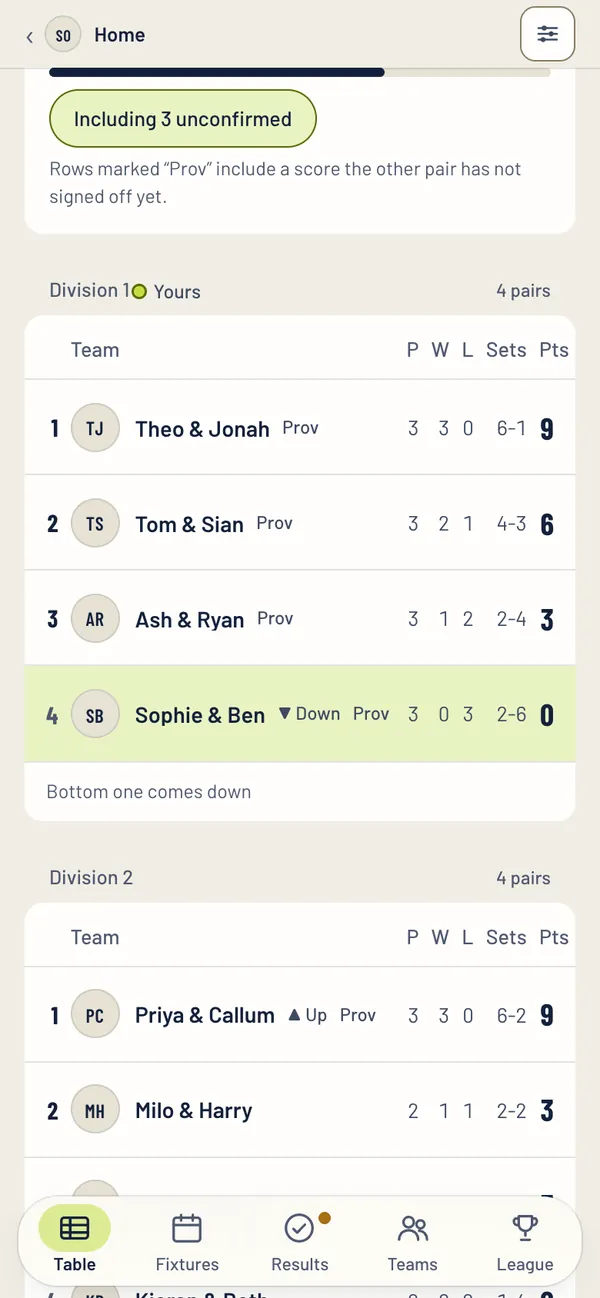
Padeliga’s Divisions style is a box league. The organiser picks fixed pairs or a new partner every week, a target division size (4 to 16), how many go up and down, and 1 to 4 rounds. Players are shared out evenly, so 24 people aiming for divisions of 10 become 2 divisions of 12, and the setup form says so before the draw. The most that can move is half a division and never more than 3, and only 1 in a division of 4. Divisions can be seeded by Playtomic level, with anyone who leaves it blank starting at the bottom, and with rotating partners the season can end with finals for the top of every division.
One pair enters each score and the other confirms it, and the division tables update at once. At the end of a season, members say in the app whether they are playing again, and staff start the next season from the last one with the ups and downs applied. More on Padeliga as a padel box league app. In the club console for padel box leagues staff see every division on one screen, with what is overdue and one Needs an answer list. Padeliga does not run a challenge ladder.
Questions
What is a padel box league?
A league in small groups of similar standard. Everyone plays everyone in their box by a deadline, then the top move up a box and the bottom move down, and a new round starts.
How many players are in a padel box league box?
There is no official number. Four to eight players or pairs is common. Bigger boxes mean more matches each round; smaller boxes mean more movement.
How long is a round in a box league?
Usually as many weeks as each player has matches: a box of six pairs at one match a week is a five week round.
How many go up and down in a box league?
Usually one or two from each box, set by the organiser before the season starts. One is kinder in a box of four.
Is there software for padel box leagues?
Yes. Look for software that shares players into boxes evenly, moves people up and down automatically, seeds by level and has both sides confirm scores. In Padeliga it is the Divisions style.
What is a good app for a padel box league?
One that lets you choose fixed pairs or rotating partners, sets the box size and how many move before the season, seeds by level, has the other side confirm every score and carries the boxes into the next round without anyone rebuilding them. Check whether you also need a challenge ladder, because many box league apps, Padeliga included, do not run one.
Run your club’s leagues in Padeliga
Members join from a code or the QR poster, agree times in the app and confirm each other’s scores, and the table updates itself. Staff see every league on one screen. Clubs get a free 90-day trial, members never pay, and leagues of 16 or fewer are free.